User experience goes beyond easily identifiable things such as visual design, and user guidance. Less obvious aspects like responsiveness and system availability also play an important — but often overlooked — role in providing an outstanding experience.
To ensure fast response times, high availability, and resilience, FNZ Studio is based on an in-memory cluster architecture that can be horizontally scaled.
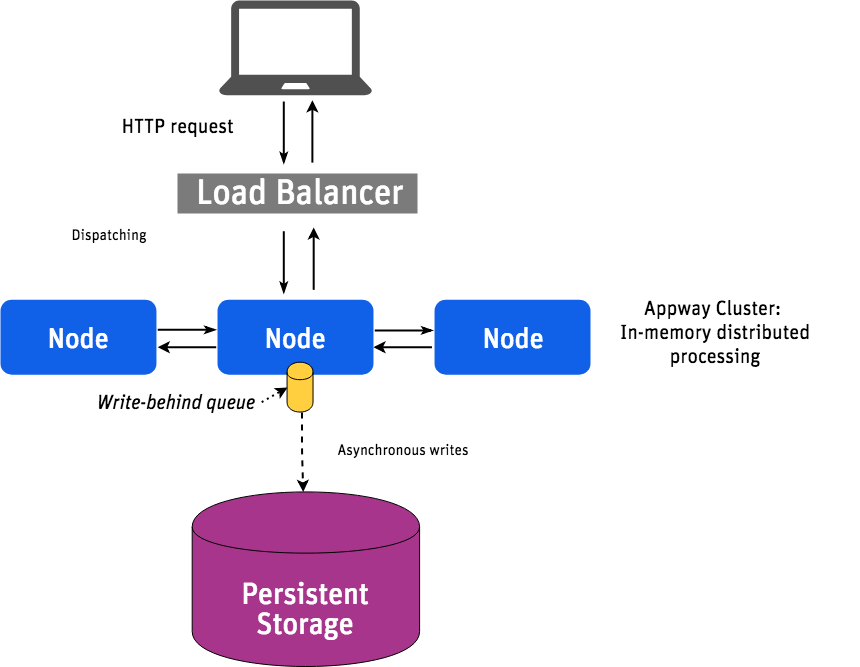
The image below illustrates the FNZ Studio architecture. A typical FNZ Studio installation consists of several nodes that manage and process distributed data collected and generated at runtime. In addition to business data entered by the user, this also includes metadata describing the process status, user data, and internal data generated by FNZ Studio itself. This data is kept in memory to ensure fast access.
Storing this data only in memory, however, is not enough. This data must survive system reboots, and be recoverable if any issues (say, hardware failure) occur. Therefore, changes to the in-memory data are also regularly written to persistent storage: the cluster storage.
Let's take a look at the write-behind queue in more detail and at how we're constantly working on improving system stability and resilience.
The write-behind queue persists changes of in-memory data to persistent storage in an asynchronous and non-blocking way. Using this approach, FNZ Studio and its end-user experience are not affected by any persistence problems.
The write-behind queue storage mechanism is implemented via MapStore Batching. MapStore Batching ensures optimized speed and stability when performing a large number of small write operations. Two related configuration properties are available:
nm.cluster.persistence.threads.count = 4 — Defines the number of threads to use for persistence. The thread pool size is 2.5 times this property to allow multiple tasks to run in parallel (for example, writing Value Stores and reading an evicted Cluster File simultaneously).nm.cluster.persistence.tasks.timeout = 60000— Sets the timeout (in milliseconds) to wait for tasks to complete. This timeout ensures that Hazelcast and HTTP threads are not indefinitely blocked.
To detect an outage / non-availability of the cluster storage, FNZ Studio has a dedicated health sensor, the Cluster Storage Sensor (see documentation), which polls every minute and is triggered if the cluster storage cannot be reached to read or write data.
System Health sensors can be monitored in FNZ Studio Composition, or from external systems using JMX or via HTTP.
With these optimizations and detection mechanisms, FNZ Studio is resilient should storage unavailability affect your system for a certain period of time (depending on system sizing/memory availability).
If the cluster storage cannot be accessed in a timely fashion and the system is under regular load, the write-behind queue will grow. To avoid memory overflow, other measures need to be taken: typically, in case of cluster storage unavailability, we recommend blocking the workspace after some time, so that you don’t run the risk of overflowing the memory of the write-behind queue. As soon as storage is brought back up, the workspace can be unblocked.
The precise metrics for workspace blocking need to be analyzed in your specific setting. They must be evaluated in accordance with the guarantees you provide to your business.
It is important to note that with a synchronous write to the persistence storage, FNZ Studio would be blocked from being used at the very moment in which the persistence layer became unavailable — and general system performance would be negatively impacted. With our in-memory architecture and asynchronous persistence, however, FNZ Studio is more resilient and provides a more reliable service to end-users.