When running a Process Instance in Appway, one of the key aspects is to have a safe and reliable data storage for the gathered data. While the Process Instance is running, the corresponding Value Store makes sure that the gathered data is stored and remains available. But in many cases, it is necessary to persist data beyond the lifetime of a specific Process Instance, or to load some data that has been previously saved. This is where Business Data Storage (BDS) comes in: BDS lets you easily persist the gathered data to a database, and also load previously saved data from a database.
BDS replaces and enhances the functionality previously provided by Data Store. BDS comes with improved performance, robustness, and security, as well as an enhanced user experience: the user interface to manage data persistence is fully integrated in the Studio, and convenient Script Functions make saving and loading the data seamless.
BDS is very easy to set-up: you don't need to take care of creating the database model or creating SQL statements to read and write data from/to the database. What you do is simply select the Data Classes you want to synchronize to the database, and at the appropriate moment in the Solution call the Appway Script Functions that will store the respective data to the database.
The rest is taken care for you under the hood. BDS transforms the Appway Data Class model into a Database model by creating Database tables for each Data Class, and the Database model is updated by BDS whenever changes are applied to the Data Class model.
You can easily configure BDS: three dedicated Studio Screens allow you to select, synchronize, and configure Data Classes, as well as to check the database content mapping. Moreover, BDS provides health sensors, so you can spot issues with synchronization early and react quickly.
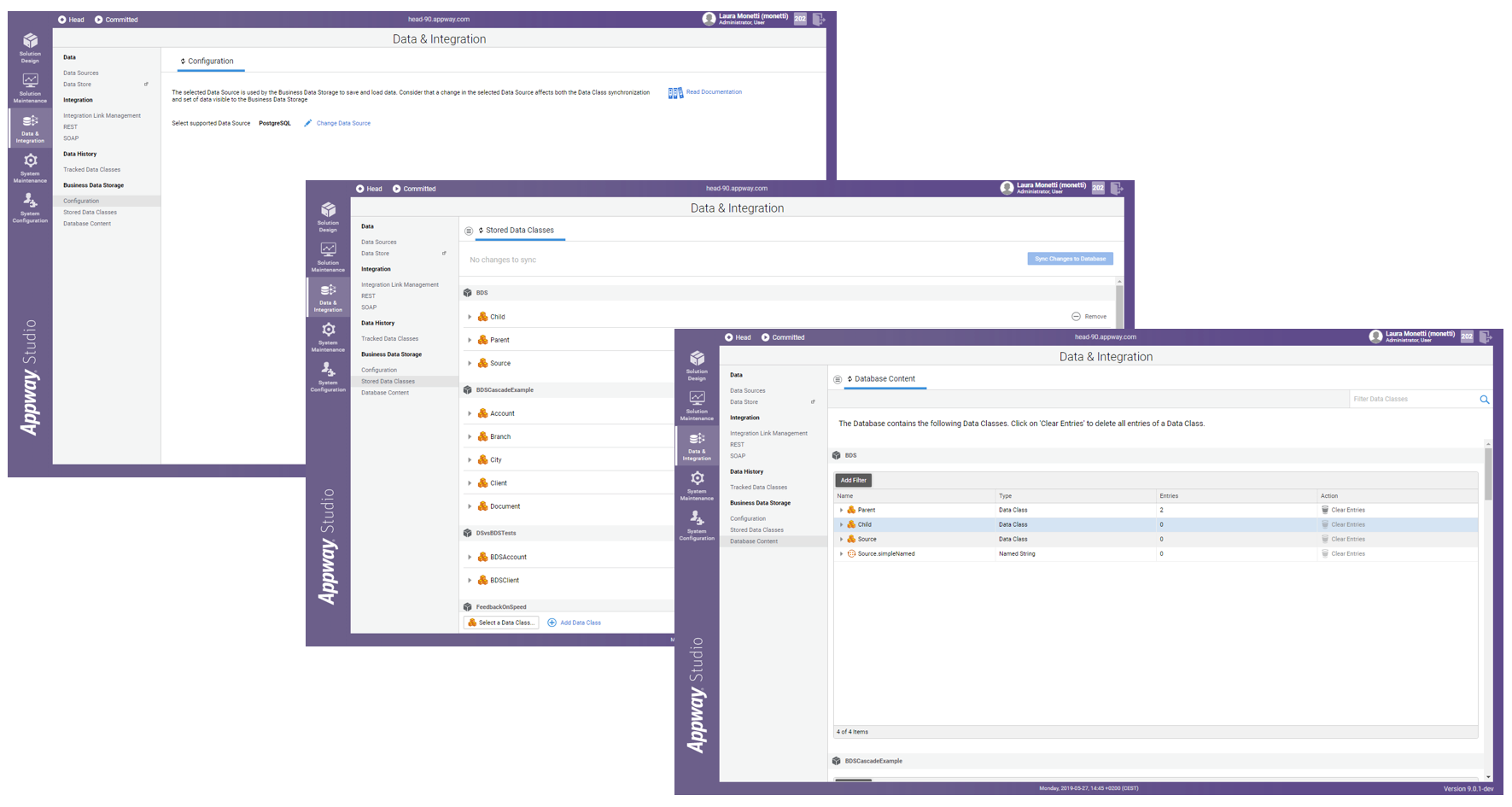
You can use BDS whenever you need to persist data beyond the lifetime of a Process Instance. We found that our customers find BDS functionality particularly useful in two main use-cases:
- When persisting data that is used only by Appway Processes, either as a stand-alone application or as part of an application ecosystem.
- As a temporary storage before integration with an external system, either when the external system does not (yet) exist, or when the external system is not yet configured for data gathering.
In both of these use-cases—and their many variations and combinations—using BDS provides data storage that is quick and easy to set-up, and allows you to shorten the time to market for your Solution.
Due to the nature of its application, it is critical that the functionality provided by BDS is scalable, robust, and secure. If you are a seasoned Appway user, you might have had experience with Data Store to persist the gathered business data. With BDS, we have improved this functionality in every possible way:
- BDS scales better for load, save, and search operations.
- BDS is more robust through data integrity and consistency checks, better handling of edge cases, and improved error handling and messages.
- BDS is more secure by allowing support for database disk and network encryption, by auditing of all database operations performed via Appway, and by disallowing free query execution from the Studio UI.
For a more in-depth analysis, and to learn more about the efforts we invested to ensure a reliable BDS release, have a look at this blog post.