This feature has been deprecated in Appway 7 and is going to be removed in future Appway versions. This means that you can currently still use this feature but should plan to phase it out. For more information on deprecation and on suggested actions, see
Feature Removal and Deprecation Planned with Appway 7.0.
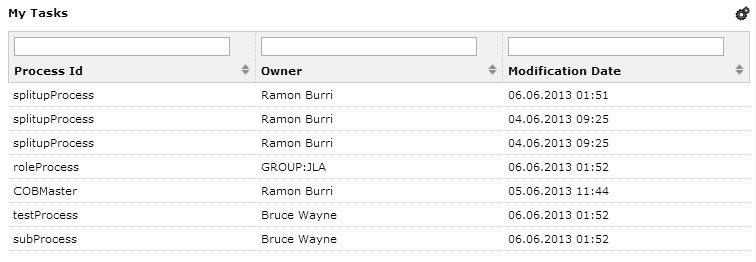
The PortalWorklist extension contains the Worklist and Worklist Column Screen Components for the management of workitems from e.g an application's portal page.
Users can directly act on the tasks assigned to them from their worklist. For example, in an HR management application, employees could see the status of their holiday requests. Their managers could view all holiday requests that are waiting for approval.
After installing the PortalWorklist Extension, you can access the Worklist and the Worklist Column components in the Screen Editor.
Drag the Worklist component onto the screen to create a new worklist and configure the properties according to your needs. Worklists have configurable columns including filtering, sorting and caching functionality, and an integrated participant tracker.
The Worklist Column component allows you to add extra columns.
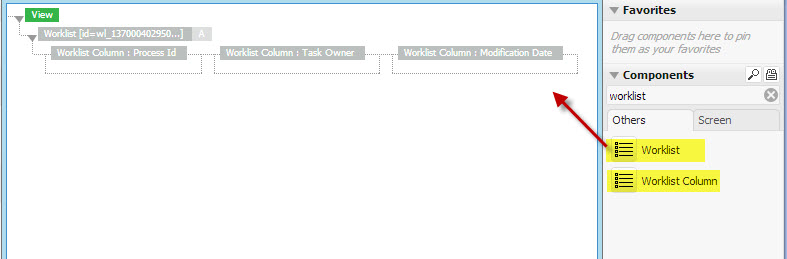
Figure 2 : Drag in a new worklist and you are ready to display your workitems
| Property | Description |
| Worklist Id | Unique Id for the Worklist Component. When copying existing worklists, give each copy a new unique id. |
| Worklist Name | Sets a name for the worklist. It will be displayed in the worklist's header. |
| Source | Select the base source of the worklist. You can choose from the Appway in-built workitem list or a database from the OfflineWorklist Extension. |
| Data Source Name | Select the data source from the OfflineWorklist Extension. |
| Iteration Variable | The iteration variable (e.g. "it_variable") is called from the custom columns or from the actions to access the workitem information. |
| Preferences | Check to display user preferences. |
| Max Rows | The maximum number of rows which will be displayed at once. If there are more workitems than this number, paging will be enabled. |
| Column Filtering | Check to enable filtering for the worklist columns. Whether a filter textbox appears in a specific column or not depends on this column's setting for its "Filtering allowed" property. |
| Alternate CSS Resource | Choose your own CSS resource for a worklist. (See Chapter 5 "Design / CSS") |
Configure your worklist with mutiple options. If you add more than one option, the result set is a union of all the options selected.
| Property | Description |
| Custom List | Check to create your own worklist with Appway scripts. Warning: this option slows down the rendering performance! |
| Custom Query | Check to use your own SQL query string for the OfflineWorklist. (See Chapter 9.2 "OfflineWorklist Custom Query") |
| Workitem Script | Check to use an Appway script expression which returns a valid indexed set of workitem objects. |
| Assigned to me | Display all workitems which are assigned to me. |
| Assigned to my groups | Check to display all workitems which are assigned to groups I am a member of. |
| Assigned to members of my groups | Display all workitems which are assigned to any member of the groups I am also member of. |
| Assigned to my roles | Display all workitems which are assigned to roles that apply to me. |
| Assigned to members of my roles | Display all workitems which are assigned to any user to whom my roles also apply. |
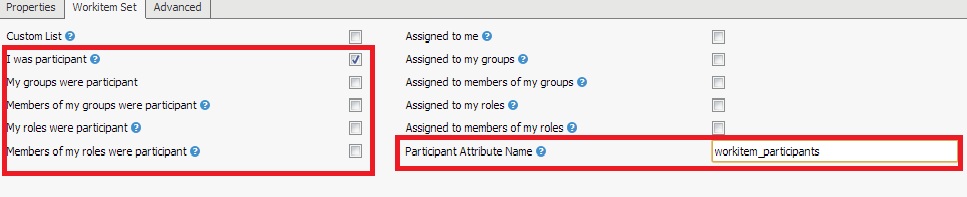
| I was participant | Display all workitems which I participated in. |
| My groups were participants | Display all workitems which any of my groups participated in. |
| Members of my groups were participants | Display all workitems which any member of one of my groups participated in. |
| My roles were participants | Display all workitems which any of my roles participated in. |
| Members of my roles were participants | Display all workitems which any user to whom my roles also apply participated in. |
| Participant Attribute Name | Name of the workitem attribute containing the participant list. (See Chapter: "Participants") |
| Process Filter* | Select or evaluate a process id which works as filter for the workitem set. |
* only available for Appway 5.3 and later releases
| Property | Description |
| Reuse other Worklist's columns | Select this option to choose another worklist and reuse selected columns. |
| Reuse columns of Worklist with Id | The id of the worklist containing the columns to be reused. |
| Affected Ajax Update Areas | Comma seperated list of Ajax Update Areas which will be triggered together with the worklist ajax update. |
| Property | Description |
| Sorting Callback | JavaScript code which will be triggered when a sorting is applied to the worklist. |
| Filter Callback | JavaScript code which will be triggered when a filter is applied to the worklist. |
| Pageing Callback | JavaScript code which will be triggered when pageing is applied to the worklist. |
| Event | Description |
| onrowclick | Defines the action when clicking on a row in the worklist |
| ondeleteclick | Defines the action when clicking on the "delete" icon (see Action Column) |
| onassignclick | Defines the action when clicking on the "assign" icon (see Action Column) |
| onviewclick | Defines the action when clicking on the "view" icon (see Action Column) |
| Property | Description |
| Column Id | Unique id for the column. When copying columns, give each copy a new unique id. |
| Column Type | Select from the default column types or add a custom one. |
| Display Name | Name for the column header |
| Column Data Type (Custom Column) | Choose the data type of the attribute to be displayed. If you choose "Icon", filtering will be disabled. |
| Custom Source (Custom Column) | Select the source of the column content. (See Chapter: "Custom Sources") |
| Script (Custom Column) | Selected "Script" as a Custom Source to enter an Appway script which return the display value. |
| Attribute Name (Custom Column) | If you select "Process Instance Attribute" or "Process Token Attribute" as Custom Source, set here the exact name of the workitem attribute to be accessed. |
| Custom Sort Value (Custom Column) | Set a value to be used as sorting criteria. |
| Filter Value (Custom Column) | Pre-filter values from the workitem list. |
| Assign: Display Condition (Actions Column) | Expression condition to evaluate if an "assign" icon will be shown in a row. |
| View: Display Condition (Actions Column) | Expression condition to evaluate if a "view" icon will be shown in a row. |
| Delete: Display Condition (Actions Column) | Expression condition to evaluate if a "delete" icon will be shown in a row. |
| Property | Description |
| Display Option | If enabled, users can choose for themselves if they want to display this column or not. |
| Sorting allowed | If enabled, the column will show up in the default sorting options of the user preferences. |
| Filtering allowed | If enabled, the column allows filtering over the content. |
| Values can be cached | If enabled, custom child content will be cached instead of reevaluated every time in order to improve performance. |
| Cache per user | If enabled, every user has a separate cache for this column. Select this option if different users should see different content or behavior for this column, e.g. because of different entitlements. |
| Cache validity [seconds] | Specify after what time a cache entry has to be refreshed. 0 means never and should be used whenever column content is static.
Warning: Changing this value requires you to restart the PortalWorkList extension for the modification to take effect! |
| Alignment | Specify how the content should be aligned within the table cell. |
The Action Column comes with three different default icons (View, Assign, and Delete). The icons can be changed / modified through the class names in the CSS file.
The following conditions are required to display an icon in a specific row:
- Write a Appway Script condition which returns true for an icon type
- Add an action in the worklist's Action Tab for that icon type
If the condition is true and an action is set, then the icon will be displayed.
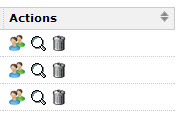
Figure 3: Actions Column with the default icons
No default actions are predefined when dragging in a new Actions Column. You can access your iterating variable in the actions to get information about the affected workitem.
Custom Columns require a source property. These are the four options available:
| Script | Select this option to enter an Appway Script in the "Script" property which returns a content value. |
| Process Instant Attribute | Select this option if you have an attribute defined on the workflow instance which you want to access. Set the exact attribute name in the "Attribute Name" property. |
| Process Token Attribute | Select this option if you have a attribute defined on the workflow token which you want to access. Set the exact attribute name in the "Attribute Name" property. |
| Children of column | Select this option to display only the screen child elements. |
"Script" & "Children of column" sources currently only offer limited support for sorting and filtering (2.2.6).
Default date columns or custom date columns can be provided with a Fromat Pattern. To enable sorting for a date or time in a custom column, set the long timestamp in the default sort order property.
To display workitems which a user participed in, it is necessary to add a list of participants to a specific Workflowinstance or Workflowtoken attribute. There are two ways to register these attributes:
- Use the built-in process listener to update attributes automatically (see: "Enable Process Listener").
- Use a manual Appway Script to update this attribute each time a new user is assigned to a workitem.
To use the automatic participants function, you have to configure the extension:
- Set the config "processlistener.enabled" to true
- Set the config "participants.attribute" to choose a global attribute name for the participants (optional)
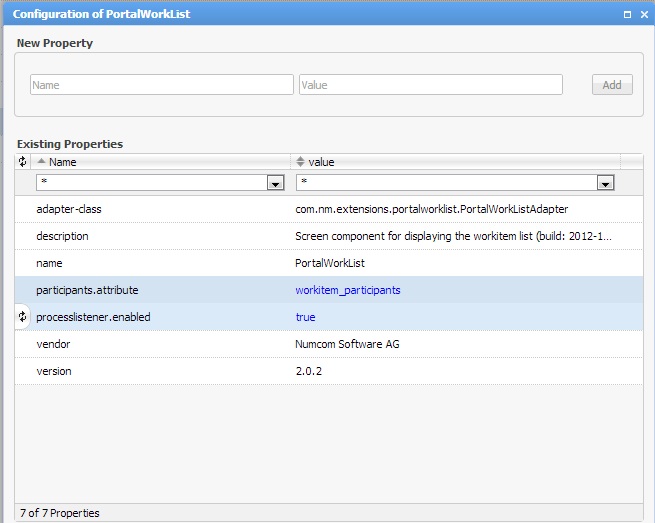
To display workitems according to the relevant process participants, select one or more participants checkboxes in the Worklist component's "Workitem Set Tab". Make sure that the "Participants Attribute Name" property has the correct attribute name.
When the Worklist component is first used on an Appway platform, a CSS resource file will be created. The CSS file "portal-worklist.css" contains all the component's default styles.
You can easily change Styles and Icons and refer to them from the Workitem property "Alternate CSS Resource".
The PortalWorklist Extension comes with an additional Format Pattern. This gives you more flexibility when displaying date or time values in your worklist. The Format Patterns can be accessed for each Date type column in the worklist through a dropdown list.
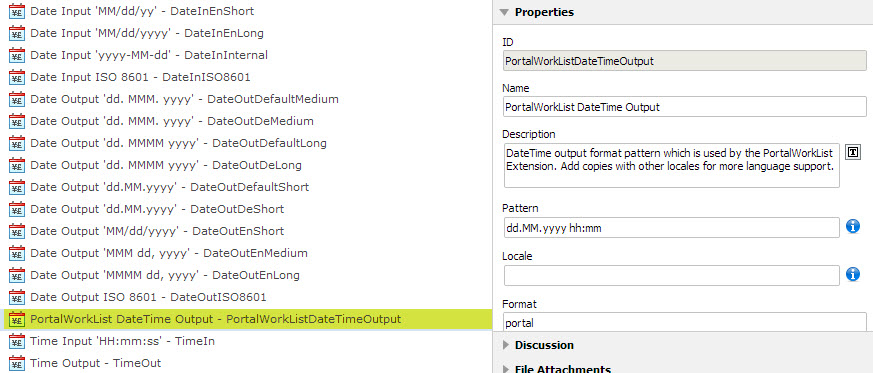
Figure 6: PortalWorklist Format Pattern
The first time you start the PortalWorklist Extension, three new Data Classes will be defined. The extension requires these classes for its data export function.
| Data Class | Description |
| PortalWorkList_Bucket | Worklist structure with workitems and data rows |
| PortalWorkList_HeaderColumn | Column information (Display Name, Default Sort Value and Column Id) |
| PortalWorkList_RowContent | Content data split into rows |
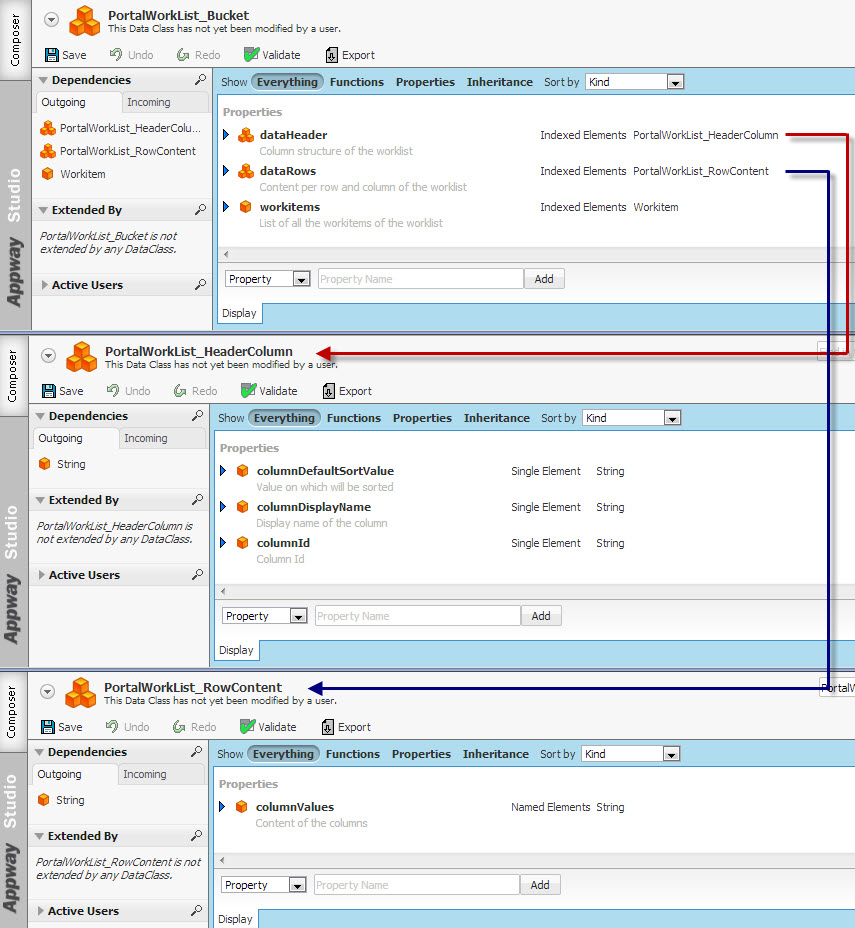
Figure 7: The 3 Data Classes which will be created by the PortalWorkList Extension
The count and the data gathering functions will slow down the screen in which they are called!
Also be careful when running these scripts in the "Render Phase."
This function returns the number of workitems for a worklist bucket. It takes two parameters: the id of the worklist and the id of the screen where the worklist is located.
Local Integer $count := CountPortalWorkListItems('wl_12345678', 'Portal')
This function returns a list of all the workitems in a bucket. It takes two parameters: the id of the worklist and the id of the screen where the worklist is located.
Local Indexed Workitem $myWorkitems := GetWorkitemsFromBucket('wl_12345678', 'Portal')
This function returns a PortalWorkList_Bucket object containing all the workitems from a worklist and the corresponding data. It takes two parameters: the id of the worklist and the id of the screen where the worklist is located.
Local PortalWorkList_Bucket $myWorklist := GetDataFromBucket('wl_12345678', 'Portal')
This is a helper function to generate JavaScript code to set a client-side filter. It takes four parameters:
- worklist id: The id of the worklist where the filter should be applied
- column id: The id of the column where the filter should be applied
- filter value: This value will be added in the filter text box
- execute: True will generate an execute event which will trigger the filter. False will merely set the filter to the filter value.
Local String $jsFilterCode := SetColumnFilterValue('wl_12345678', 'col_1234', 'subProcess', true)
The OfflineWorklistClient Extension is supported since version 2.5.3.
To use the two extensions together, it is necessary to set a few OfflineWorklist configurations. This will add additional columns to the database tables and provide extended support.
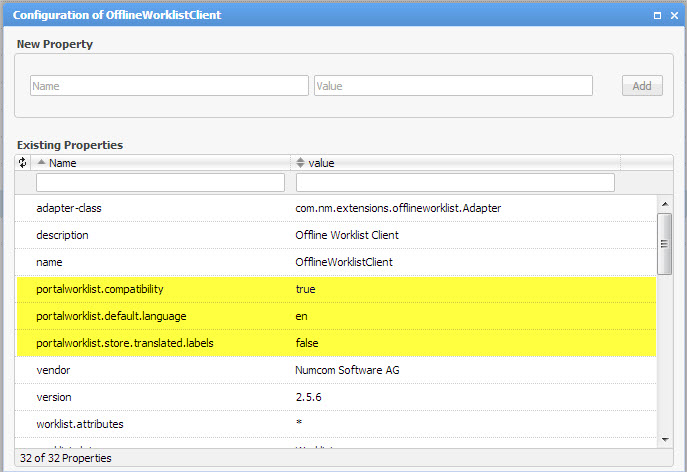
Figure 8: OfflineWorklist configurations for the PortalWorklist
When using a custom query, take the need of the columns in the select statement into account. Take the original query for customizations:
SELECT wfi.systemId, wfi.workflowInstanceId, wfi.workflowId AS rootWorkflowId,
wft.workflowTokenId, wft.userId, wft.status, wft.elementId, wft.creationTime,
wft.modificationTime, wft.workflowId, wft.elementName, wft.elementTaskListName,
wft.phaseName, wft.phaseTaskListName, wft.swimlaneName, wft.swimlaneTaskListName

FROM workflowInstances wfi, workflowtokens wft

WHERE wfi.workflowInstanceId = wft.workflowInstanceId
AND wfi.status = 'Active'
AND wft.userId IN ('NM')
Please note that, when selecting the property "My roles were participant" in the Workitem Set Tab, the Roles "Administration" and "User" are ignored.
If the Business Activity Monitoring (BAM) extension is installed on your Appway platform, you gain access to two supplementary default Worklist columns. "Process SLA" and "Activity SLA" are the equivalent in the BAM Extension and will display the SLAs defined.
Read more about Business Activity Monitoring (BAM).
The following Appway export file contains various example worklists with different configurations.
example_all_kind_of_worklists.awexport
This Screen shows an example of the interaction between a pie chart from the Charting Extension and the Worklist. The requirement is to reprsent a drill-down of the workitems in a pie chart.
example_ChartingExtension_with_PortalWorkList.awexport
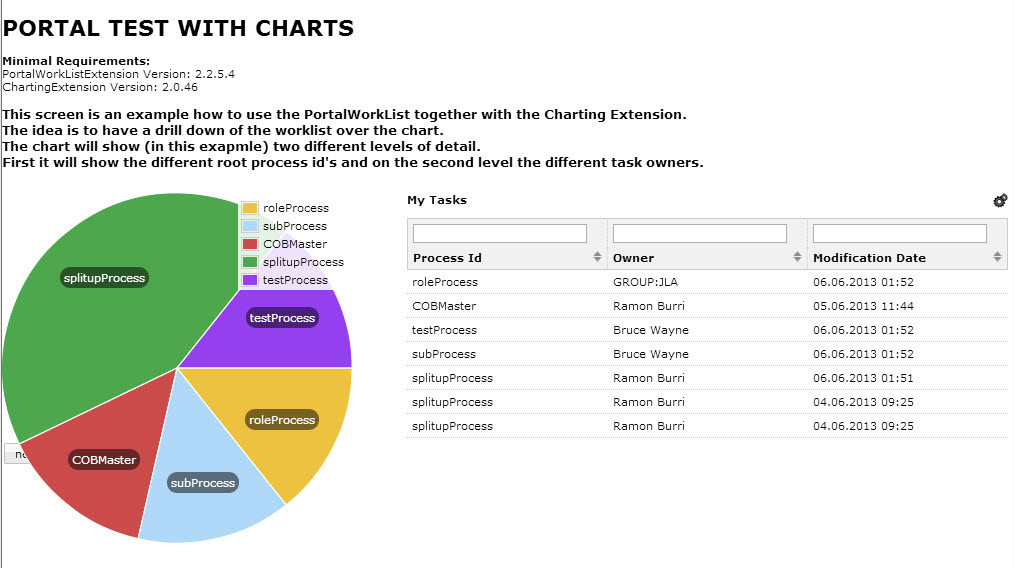
Figure 9: Charting drill-down of workitems
- Worklist components are containers: They can be surrounded with conditions and filled with other screen components.
- When copying a worklist or a worklist column, you are also duplicating the components's id. Make sure you use a unique id for each component to reduce errors.
- Try to use the checkbox-oriented workitem set generator. If you use custom queries or Appway scripts, renderning could be slowed down dramatically.
- Be creative when creating a Portal screen. If you have more than one bucket, then place them in tabs and load only one bucket at a time.
- Use default columns when possible. If you have to make custom ones, try to go for the process instance attribute variation and do not use many scripts. The data gathering is optimized for token or instance attributes.
- Using the GetDataFromBucket or the GetWorkitemsFromBucket functions will generate almost as much load as the worklist itself. Carefully evaluate whether you really need to use these functions.
The following two validation warnings may occur when composing screens with the Worklist component. These warnings can safely be ignored.

Figure 10: Validation warnings for the Worklist component